
Understanding the Farragut, TN Housing Market | Part 3
Buying in a More Balanced Market
Quick Answer
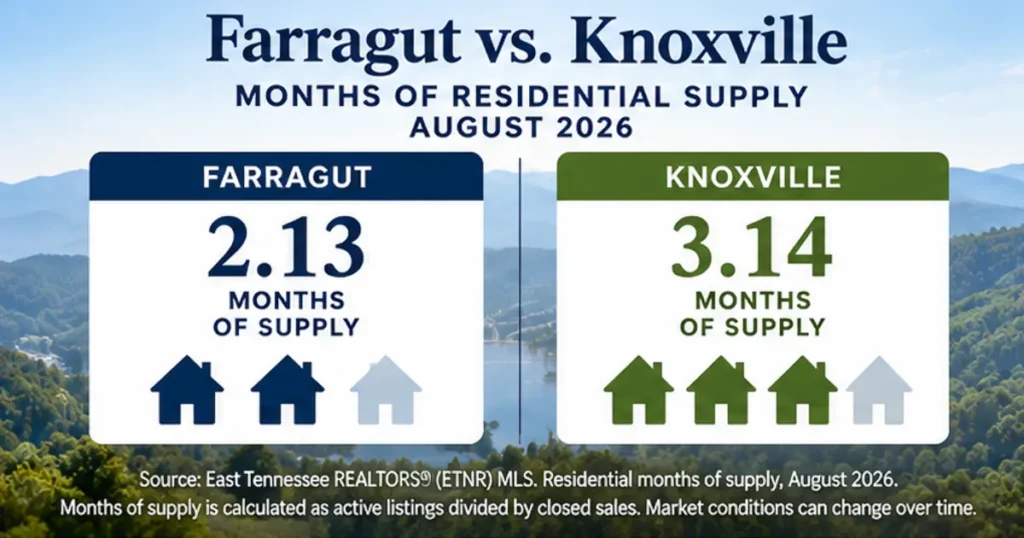
Waiting to buy a home in Farragut may give you more choices or negotiating opportunities, but a more balanced housing market doesn’t necessarily mean lower home prices. The broader Knoxville market has become more balanced than it was during the highly competitive years, but conditions vary considerably by location. Farragut remains a tighter, seller-favorable market, with ETNR MLS data showing approximately 2.1 months of residential inventory in August 2026, compared with approximately 3.1 months in Knoxville.
Buyers may have more time to evaluate a property, negotiate on some listings or ask for concessions than they did when competition was at its peak. But slower appreciation isn’t the same as falling home prices, and waiting for the market to become more balanced doesn’t guarantee that a particular Farragut home will become less expensive.
Whether waiting makes sense depends less on trying to predict the market and more on your finances, how long you expect to own the home, what properties are available and whether the right house is available at a price and condition that make sense for you.
There isn’t one “housing market.” Even within the Knoxville area, market balance can look quite different in Farragut.
Farragut Buyers Are Asking a Different Question Now
In Part 2 of Understanding the Farragut, TN Housing Market, I looked at the other side of the affordability question: how Farragut’s high home prices and limited single-family rental inventory may create opportunities for rental-property investors—but only when the purchase price, property condition and realistic rent make sense together.
For several years, much of the conversation surrounding real estate was about competition.
How quickly do I need to make an offer? How much competition will there be? Will the house sell before I can see it? How much above asking price will someone else pay?
As the East Tennessee housing market normalizes, the conversation is changing.
More buyers are asking:
“Should I wait?”
It’s a reasonable question.
If inventory improves, competition eases and home-price appreciation slows, it seems logical to wonder whether waiting another six months or a year could result in a better deal.
The difficulty is that several different things tend to get lumped together when people say the housing market is “slowing.”
A market can experience slower appreciation without prices falling. It can become more balanced without becoming a buyer’s market. Sellers can become more negotiable while desirable houses continue selling.
Those are very different conditions.
Understanding those differences is more useful than trying to guess exactly where home prices will be next year.
Slower Appreciation Isn’t the Same as Falling Home Prices
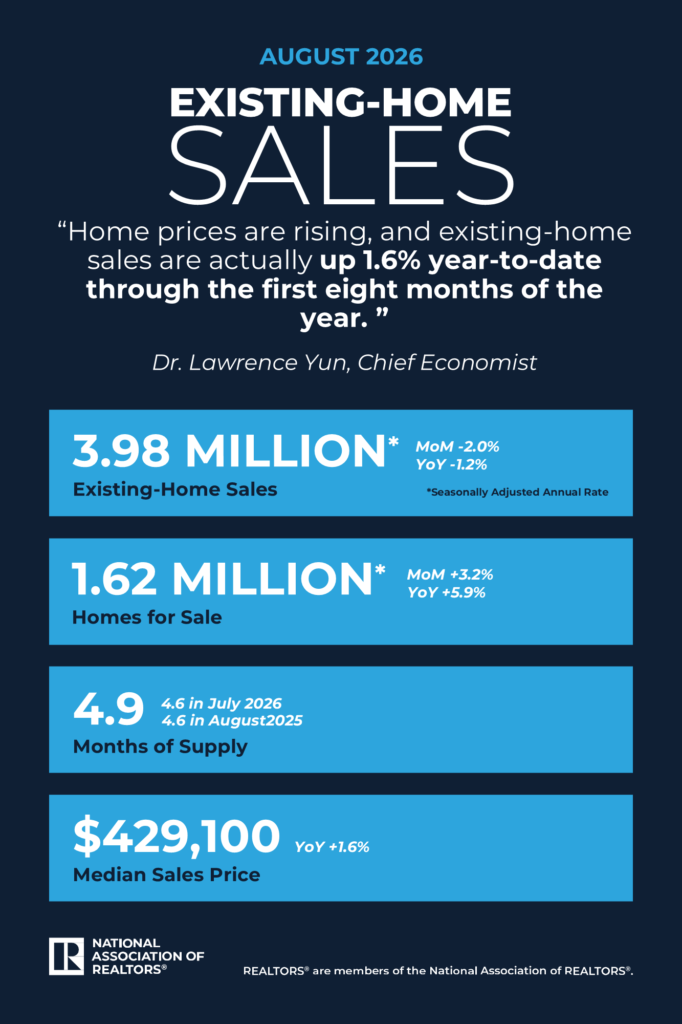
Source: National Association of REALTORS®, Existing-Home Sales Housing Snapshot, August 2026.
What this means in Farragut: More inventory doesn’t automatically mean falling home prices. Buyers may gain more choices and negotiating room as supply improves without homes necessarily becoming less expensive. Farragut shows a similar distinction: local home values remain higher than a year ago even as buyers are gaining some negotiating flexibility.
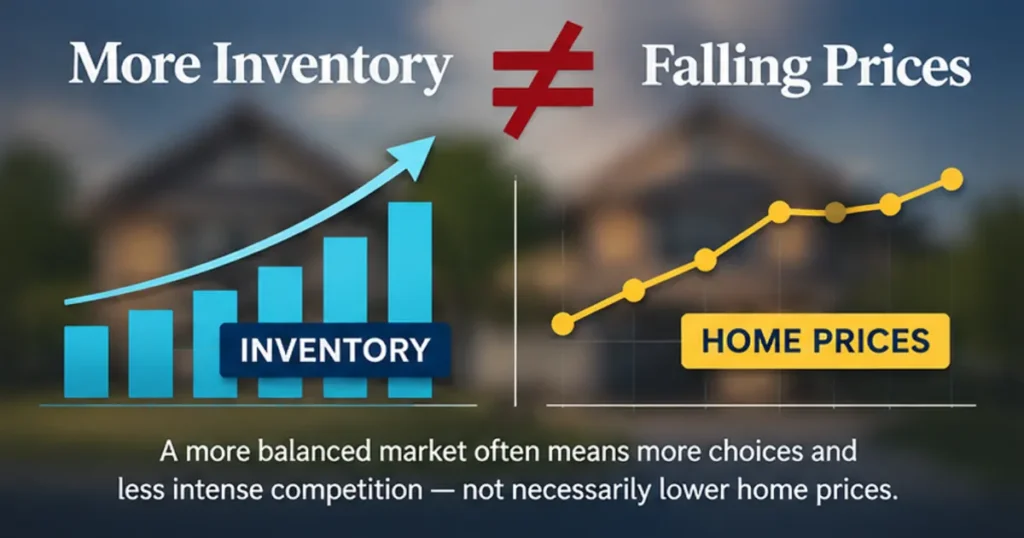
This may be the most important distinction for someone considering whether to wait.
Suppose a home’s value rises rapidly for several years and then increases only slightly the following year.
The market has slowed considerably.
But the house didn’t become cheaper.
That’s the difference between slower appreciation and depreciation.
Nationally, the National Association of REALTORS® reported that home prices increased in 80% of metropolitan markets during the second quarter of 2026, compared with 71% during the first quarter. The national median existing single-family home price increased 1.5% from a year earlier to $434,900.
Twenty percent of the metropolitan markets tracked by NAR did experience year-over-year price declines, so declining prices certainly can occur.
But nationally, slower price growth has not translated into universal price declines.
Farragut shows a similar distinction.
Zillow reported the typical Farragut home value at approximately $691,336 as of August 31, 2026, which was still 1.9% higher than one year earlier.
So far, the local story isn’t simply “prices are falling.”
It’s more nuanced.
The pace and character of the market are changing.
What Does a More Balanced Market Actually Give a Buyer?
This is where today’s market can become more interesting.
A buyer doesn’t necessarily need the median Farragut home price to fall dramatically to be in a better negotiating position than someone purchasing during an intensely competitive market.
Zillow’s July 2026 Farragut data showed a median sale-to-list ratio of 98.4%. Approximately 63.4% of sales closed below the final list price, while 19.7% closed above it.
East Tennessee REALTORS® found another indication of increased negotiating flexibility. In its Q2 2026 Market Pulse Survey, the percentage of contracts where the appraised value met or exceeded the contract price declined from 97% in Q2 2025 to 93% in Q2 2026. ETNR said that change suggested buyers may have slightly more negotiating flexibility than they did a year earlier.
That doesn’t mean every Farragut seller is ready to negotiate.
It means buyers may increasingly encounter opportunities that were harder to find during a more frantic market.
| A More Balanced Market May Provide | Why It Matters |
|---|---|
| More homes to consider | Buyers may have less pressure to settle for the first acceptable property |
| More negotiating opportunities | Some sellers may consider reasonable price or term negotiations |
| More time for due diligence | Buyers may have greater opportunity to investigate the property carefully |
| Fewer extreme bidding situations | Asking price may have a stronger relationship to the eventual contract price |
| Greater attention to property condition | Deferred maintenance may receive greater buyer scrutiny when competition eases |
| More leverage on stale inventory | A house that has been sitting may present a different negotiation than a new listing |
For someone buying an older Farragut home, that last point can be particularly important.
A little more negotiating room can matter.
But having enough time to determine whether the roof, HVAC, electrical system, plumbing or other major components need attention may matter even more.
A Better Buyer’s Market Doesn’t Necessarily Mean a Cheaper Buyer’s Market
This is where I think buyers can make a mistake.
Imagine a $500,000 house.
A buyer decides to wait because they believe the market may soften.
Suppose the following year a similar property can be purchased for slightly less—or perhaps at roughly the same price with better negotiating terms.
Waiting may have worked.
But there are other possible outcomes.
The house could sell, prices could remain relatively flat, prices could continue appreciating modestly, the buyer’s financial circumstances could change, or the type of property the buyer wants could become harder to find.
Meanwhile, the buyer still needs somewhere to live.
That’s why waiting has a cost, just as buying has a cost.
That cost isn’t the same for everyone. Someone living inexpensively with family has a very different waiting calculation from someone paying substantial monthly rent. Someone who expects to relocate within two years has a different calculation from someone planning to remain in Farragut for fifteen years.
There isn’t one mathematical answer that applies to all of them.
When Waiting Deserves Serious Consideration
There are legitimate reasons to delay purchasing a home, and they have very little to do with predicting next year’s median sale price.
If purchasing a house would leave you without adequate emergency reserves, waiting may make sense. If paying down other debt would materially improve your financial flexibility, waiting may make sense. If your employment or geographic plans are uncertain, committing to a house may not be appropriate yet.
The same applies when you simply haven’t found the right property.
I don’t believe buyers should purchase a house merely because they’ve decided this is the year they’re supposed to buy one.
Before moving forward, I would want a buyer to be comfortable with several things:
- The purchase fits the household budget without depending on everything going perfectly.
- Adequate savings remain after closing.
- The buyer expects to remain in the home long enough for ownership to make sense.
- The property’s condition and likely near-term expenses are understood.
- The house meets enough of the buyer’s actual needs to justify the commitment.
- The decision still makes sense without assuming rapid future appreciation.
If several of those pieces aren’t in place, waiting can be a rational financial decision.
That’s very different from waiting because someone on television or social media said home prices are about to collapse.
When Waiting Becomes Market Timing
Market timing sounds simple in hindsight.
Buy when prices reach the bottom. Sell when they reach the top.
The problem is recognizing either one while it’s happening.
If you’re waiting specifically for Farragut home prices to decline by some particular amount, several things have to go your way. Prices have to decline, the type of house you want has to be available when they do, your personal and financial circumstances have to remain favorable, and you have to recognize the opportunity when it arrives.
Even then, purchase price is only one part of the equation.
This is why I think buyers are better served by separating two questions:
Question 1: Am I ready to buy?
Question 2: Is this particular house worth buying?
The first is primarily about your finances, plans and lifestyle.
The second is about the property, its price, its location, its condition and the alternatives available at that moment.
Neither question requires correctly predicting next year’s housing market.
The Right House Can Matter More Than a Small Market Movement
This becomes especially important in a community such as Farragut.
Real estate isn’t interchangeable.
A house in Kings Gate isn’t identical to one in Stonecrest. A 1970s home that has undergone substantial renovation isn’t economically equivalent to another house of the same age that still needs major systems replaced.
Even two houses on the same street can have very different ownership costs.
Suppose a buyer waits for prices to decline but passes on a well-maintained property with a newer roof, updated HVAC, modernized electrical components and appropriate improvements.
Six months later, another house becomes available for less money.
If the second house needs a roof, HVAC system and significant additional work, did waiting actually produce the better purchase?
Maybe.
Maybe not.
The asking price is only one number on a house.
That was an important point in Part 1 of this series, and it becomes even more important in a more balanced market.
When buyers have additional choices and negotiating leverage, property condition deserves more attention—not less.
What About Mortgage Rates?
Mortgage rates obviously affect affordability, but I don’t think buyers should build an entire home-buying strategy around predicting where rates will go next.
Rates change. Financing options vary. Individual qualifications vary.
If rates eventually decline, that could improve affordability for some buyers. But lower borrowing costs can also influence buyer demand, which may affect competition for homes.
If rates remain elevated, buyers may continue placing greater emphasis on price and negotiation.
Either way, trying to predict both future home prices and future borrowing costs introduces two uncertain variables instead of one.
A qualified mortgage professional can explain current financing options and qualification based on an individual buyer’s circumstances.
From the real-estate side, my focus is different:
Does the house make sense at today’s price, in today’s condition, under circumstances the buyer understands today?
What the Current Data Actually Tells Us
As of September 2026, I don’t think the available evidence supports reducing the Farragut market to either extreme.
It isn’t simply:
“Prices are still going up, so buy immediately.”
And it isn’t:
“The market is slowing, so wait because houses will be cheaper.”
The evidence is more useful than either slogan.
Farragut home values remain high and Zillow’s typical value was still up 1.9% year over year through August. At the same time, nearly two-thirds of July Farragut sales in Zillow’s data closed below the final list price.
East Tennessee REALTORS® reported that only 45% of Q2 2026 survey respondents expected home prices to increase over the following year, compared with 58% in Q2 2025. Expectations for increasing home sales also declined from 44% to 36%.
But the same survey found more real estate professionals working with three or more active buyers than the year before, suggesting that buyer demand had not disappeared even as market expectations moderated.
That’s what normalization can look like.
Not a boom.
Not necessarily a bust.
A market where buyers and sellers have to think more carefully about the individual transaction.
So, Should You Wait to Buy a Home in Farragut?
Maybe.
But the reason matters.
Waiting because you need six months to build savings is a plan.
Waiting because you need to reduce debt is a plan.
Waiting because your job may relocate you next year is a plan.
Waiting because the available houses don’t justify their asking prices is a plan.
Waiting because you haven’t found a house whose price, condition and location make sense is a plan.
Waiting indefinitely because you’re certain you can identify the bottom of the Farragut housing market before everyone else does is a prediction.
Those aren’t the same thing.
For someone who is financially prepared, expects to remain in the area and finds the right property at a price and condition that make sense, a more balanced market may actually provide opportunities that weren’t available when buyers had considerably less negotiating power.
For someone who isn’t ready, a changing market doesn’t create an obligation to buy.
That’s why my answer to “Should I wait?” begins with another question:
What are you waiting for?
If there’s a concrete financial or personal objective on the other side of that waiting period, it may be entirely reasonable.
If the answer is simply, “I’m waiting until I know prices have reached the bottom,” that’s a much harder strategy to execute.
A better market for buyers doesn’t necessarily mean a cheaper market for buyers.
Sometimes what makes it better is having enough choice, time and negotiating room to make a better decision.
Frequently Asked Questions
Are Farragut home prices falling?
Not according to Zillow’s year-over-year home-value measure as of August 31, 2026. Zillow reported a typical Farragut home value of approximately $691,336, up 1.9% from a year earlier. Individual properties and price segments can behave differently from market-wide averages.
Is Farragut becoming a buyer’s market?
The market has shown signs of becoming more balanced, but “more balanced” and “buyer’s market” aren’t necessarily the same thing. East Tennessee REALTORS® has reported increased normalization and some evidence of greater buyer negotiating flexibility while also reporting continued housing demand.
Are Farragut sellers negotiating?
Some are. Zillow reported that 63.4% of Farragut sales in July 2026 closed below their final list price. That does not mean every seller will negotiate or that the difference was substantial in every transaction.
Will Farragut home prices be lower next year?
Future home prices cannot be known with certainty. Current indicators can describe today’s market and recent direction, but they cannot guarantee where prices will be at a particular future date.
Should I wait for mortgage rates to fall before buying?
That depends on your circumstances. Future rates are uncertain, and changes in rates can also influence buyer demand and competition. A mortgage professional can evaluate current financing options and qualification based on your individual circumstances.
Is an older Farragut home a better value?
Sometimes, but age alone doesn’t determine value. Established neighborhoods can offer lower acquisition prices than some newer areas, but roof, HVAC, electrical, plumbing, windows, drainage and other major components should be evaluated carefully.
What’s the best reason to wait before buying?
A specific reason tied to your own circumstances—building savings, reducing debt, improving financial flexibility, resolving employment or relocation uncertainty, or waiting for a property that better fits your needs—is more concrete than trying to predict the exact bottom of the housing market.
Coming Next: Is Renting Still the Affordable Alternative to Buying in Farragut?
If waiting to buy means renting longer, that raises another affordability question: Is renting still the less expensive—or even affordable—alternative?
National research shows that housing-cost pressure isn’t limited to homeowners or prospective buyers. A growing share of renters, including middle-income renters, are reporting difficulty keeping up with monthly housing costs. At the same time, Farragut has a limited supply of single-family rentals, and the rent a property can command ultimately has to be supported by the local market.
In Part 4 of Understanding the Farragut, TN Housing Market, we’ll look at the difference between renting being less expensive than buying and renting actually being affordable—and what that distinction means for renters, prospective buyers and rental-property investors in Farragut.
Next: Is Renting Still the Affordable Alternative to Buying in Farragut, TN? →
Considering Buying a Home in Farragut?
A market statistic can’t tell you whether a particular house is a good purchase for you.
That’s where the analysis becomes more useful.
My background includes approximately three decades in residential contracting in addition to my real-estate experience. When considering an older Farragut home, I’m interested in the asking price and comparable sales—but I’m also considering the roof, HVAC, electrical system, plumbing, drainage, exterior components, renovations and other factors that can affect what owning that house may actually cost.
In a more balanced market, buyers may have something extremely valuable:
More opportunity to be selective.
If you’re considering buying in Farragut, I can help you evaluate the property itself as carefully as the market around it.
The next step is to see what your choices actually look like. Browse current Farragut homes for sale, compare asking prices and properties, and see whether there’s a home on the market today that’s worth taking a closer look at.
Search Farragut Homes for Sale →
David Hamilton, REALTOR®
Weichert, Realtors – Advantage Plus
Farragut & West Knoxville, Tennessee
This article is provided for general real-estate education and market discussion. It is not financial, tax, investment or lending advice and does not constitute an offer of credit. Market conditions can change, and future home prices, interest rates and property values cannot be predicted with certainty. Consumers should consult appropriate mortgage, financial, tax and other professionals regarding their individual circumstances.
Sources & Market Data
Zillow — Farragut, Tennessee Housing Market
Farragut home-value, sale-to-list and sale-price data through August 2026.
East Tennessee REALTORS® (ETNR) MLS
Based on information from the East Tennessee REALTORS® MLS for August 2026. Residential market statistics reflect the City of Farragut and City of Knoxville and were accessed September 28, 2026. MLS information is deemed reliable but not guaranteed.
East Tennessee REALTORS® — Q2 2026 Market Pulse Survey
Survey of 126 East Tennessee REALTORS® members conducted July 1–17, 2026. Referenced for buyer/seller trends, appraisal results, market expectations and negotiating conditions.
National Association of REALTORS® — Existing-Home Sales Housing Snapshot, August 2026
Referenced for national existing-home inventory, months of supply, median price and year-over-year price change.
National Association of REALTORS® — Metropolitan Median Area Prices and Affordability, Q2 2026
Referenced for national metropolitan home-price trends and the percentage of markets experiencing year-over-year price increases and declines.


1 thought on “Should I Wait to Buy a Home in Farragut, TN? What a More Balanced Market Really Means”