At a Glance: Why the Virtue Mill Site Matters
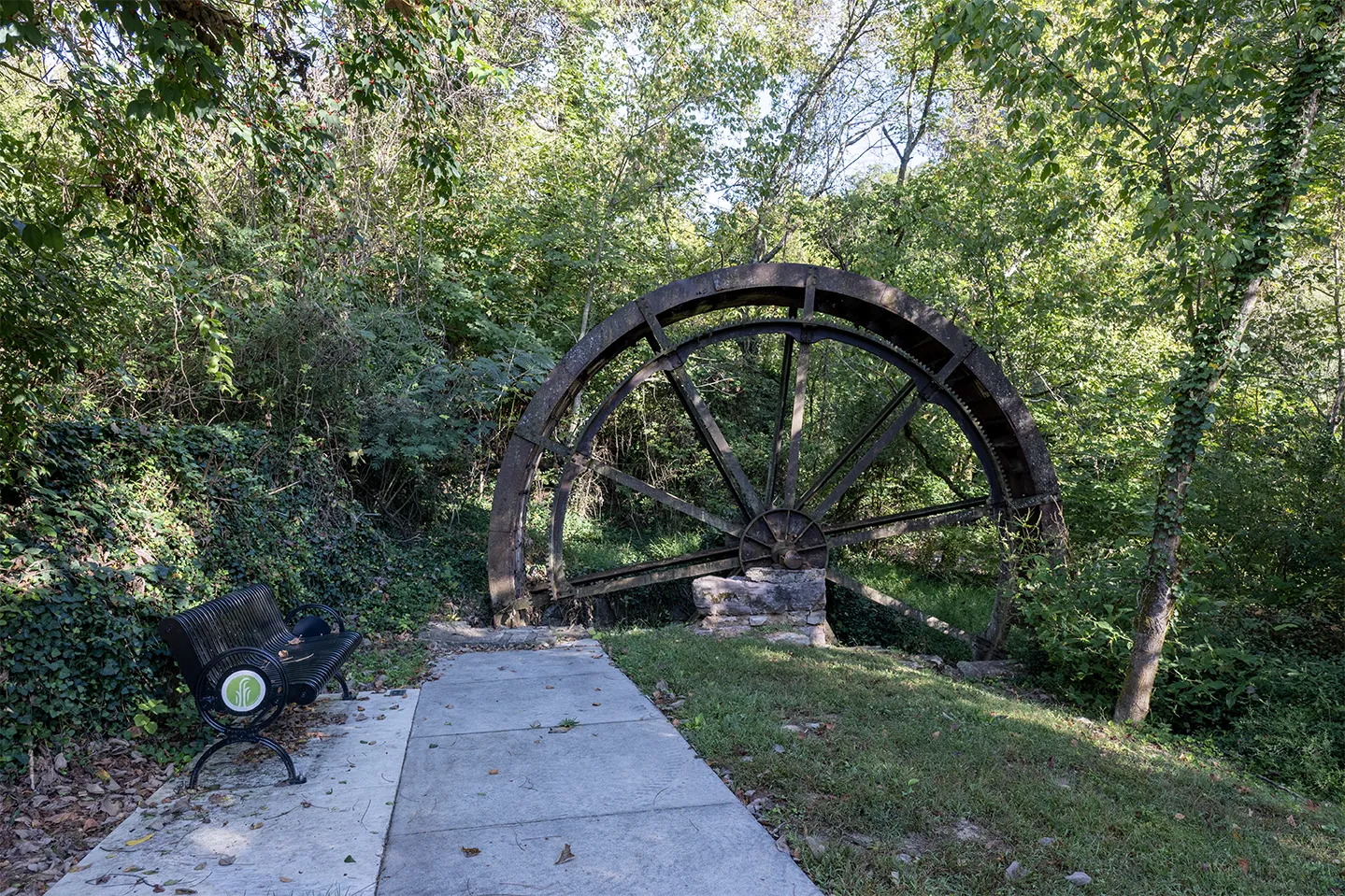
The old Virtue Mill waterwheel beside Little Turkey Creek is one of Farragut’s surviving links to the community’s past. The mill was built sometime in the 1840s or 1850s and remained standing until it was destroyed by fire in 2002 while preservation efforts were underway.
The site has another important connection to local history. On November 16, 1863, soldiers of the 17th Michigan Volunteer Infantry fought Confederate forces around Little Turkey Creek as part of the Battle of Campbell’s Station and the Union Army’s withdrawal toward Knoxville. A Civil War interpretive marker now identifies the Virtue Mill site with that action.
Today, the waterwheel and marker can be reached from a paved trail off Virtue Road, at a point where Farragut’s modern greenway network passes through a landscape with more than 160 years of documented history.
What Is the Old Waterwheel on Virtue Road?
If you travel Virtue Road in Farragut today, it would be easy to pass this location without realizing how much history is tucked away beside Little Turkey Creek.
The large metal waterwheel is what remains of Virtue Mill, a historic mill built sometime in the 1840s or 1850s.
Information about the mill’s earliest years is limited. Research by the Knoxville Civil War Roundtable notes that there are few surviving records documenting its operation. By late 1862, the property was owned by Robert G. and William L. Russell, who also owned the Campbell Station Inn. Their uncle, Matthew Russell, may have built the original mill.
The mill continued to have a place in the community long after the Civil War. Later historical accounts describe it as serving at various times as a mill, store, post office and community gathering place.
By the late 20th century, however, the mill was no longer operating.
A statewide study of historic Tennessee mills recorded Virtue Mill as non-operating and described its overshot waterwheel, a breached dam and a building already in poor condition. The study also noted that the building had most recently been used as a packing plant rather than as an operating mill.
What Happened to Virtue Mill?
By 2000, there was an effort to save the deteriorating mill.
Contemporary reporting described a local preservation effort aimed at restoring Virtue Mill rather than allowing the structure and its remaining machinery to disappear. At the time, supporters pointed not only to the age of the building but also to the machinery that remained inside it.
The effort ultimately ran out of time.
Virtue Mill was destroyed by fire on June 2, 2002, while plans for its restoration were being made. The Town later incorporated the mill site into its inventory of historically significant locations.
The building is gone.
The waterwheel remains.
And there is another reason this particular location matters.
What Happened Here During the Civil War?
On November 16, 1863, Union and Confederate armies fought the Battle of Campbell’s Station in what is now Farragut.
The battle was part of Confederate Lt. Gen. James Longstreet’s Knoxville Campaign.
Union Maj. Gen. Ambrose Burnside was moving his Army of the Ohio toward Knoxville. Longstreet was trying to get there first and prevent Burnside from reaching the city’s defenses.
Both sides were effectively racing toward Campbell’s Station.
The National Park Service describes Campbell’s Station as a strategically important crossroads where Concord Road from the south intersected Kingston Road leading toward Knoxville. Burnside’s advance reached the intersection first on November 16 and deployed before Longstreet’s forces arrived.
Longstreet attempted to attack both Union flanks. Burnside’s troops resisted the Confederate attacks and then withdrew to another position before continuing toward Knoxville.
The National Park Service estimates approximately 970 casualties in the Battle of Campbell’s Station—about 400 Union and 570 Confederate.
But that larger battle is only part of the story at Virtue Mill.
The 17th Michigan at Little Turkey Creek
As Burnside’s army withdrew toward Knoxville, rear-guard units were responsible for slowing the Confederate advance and protecting the retreat.
Among those troops was the 17th Michigan Volunteer Infantry Regiment.
The 17th Michigan served in the rear guard along with the 2nd Michigan, 20th Michigan and 100th Pennsylvania.
Confederate forces caught up with the 17th Michigan’s skirmishers around Turkey Creek. A historical marker near Evans and Virtue roads describes the action as occurring a few hundred yards from that marker. A newer interpretive marker at the Virtue Mill site says the fighting is believed to have occurred at that location.
That distinction is worth preserving because historical interpretation can become more precise as additional research is completed.
What is well documented is the 17th Michigan’s role in the fighting here.
With the regiment in danger of being cut off, Capt. Frederick Swift and flag bearer Sgt. Joseph Brandle helped rally the soldiers as they withdrew across the creek and toward higher ground.
The fighting around the regiment’s colors was intense. Brandle continued carrying the flag after being wounded, including an injury that cost him the sight of one eye. Swift took up the colors after other members of the color guard had been hit and helped rally the regiment. Both men later received the Medal of Honor for their actions.
The 17th Michigan’s role here was not incidental. The regiment suffered seven killed and 52 wounded during the fighting at Campbell’s Station. By the time historian Earl J. Hess places it north of Kingston Road near the Matthew Russell House, the regiment had already been engaged earlier in the day’s fighting near Little Turkey Creek.
That movement would carry the regiment from the area explored here into the larger battlefield across what is now modern Farragut..
Was the Battle of Campbell’s Station Fought at Virtue Mill?
The Virtue Mill area was part of the larger Battle of Campbell’s Station—but with an important qualification.
The National Park Service places the strategically important Campbell’s Station crossroads where Concord Road met Kingston Road. Burnside reached that junction ahead of Longstreet, deployed his forces and later conducted an organized withdrawal toward Knoxville.
The fighting involving the 17th Michigan around Little Turkey Creek occurred as part of that larger military action.
The distinction matters today because the modern landscape can make it difficult to visualize the scale of the battlefield.
Present-day Farragut contains neighborhoods, businesses, roads and other development across land involved in the events of November 16, 1863.
The Virtue Mill site gives us something different: a specific physical location where a visitor can still stand beside the creek and see a surviving landmark associated with the landscape.
Why Were Burnside and Longstreet Fighting at Campbell’s Station?
The Battle of Campbell’s Station was fundamentally a race for Knoxville.
Longstreet had been detached from the Confederate Army of Tennessee near Chattanooga and sent toward Knoxville to confront Burnside’s Union forces.
Burnside wanted to reach Knoxville and its prepared defenses.
Longstreet wanted to intercept him before he could get there.
Campbell’s Station mattered because of the road network.
The intersection of Concord Road and Kingston Road controlled Burnside’s route toward Knoxville. Burnside’s troops reached the crossroads first, and Longstreet arrived shortly afterward.
After several hours of fighting, Burnside continued his withdrawal toward Knoxville. By November 17, most of the Union army was inside the city’s defensive lines. Longstreet followed, beginning the Confederate siege of Knoxville.
That campaign would soon lead to another significant engagement at Fort Sanders.
Two Medal of Honor Recipients Are Connected to This Location
The actions of Frederick Swift and Joseph Brandle give the Virtue Road site an especially interesting connection to Civil War history.
A historical marker near Evans and Virtue roads commemorates both men and the 17th Michigan.
The marker identifies the unit as part of the rear guard protecting Burnside’s retreat and credits Swift and Brandle with helping prevent Confederate forces from overrunning the regiment and the rest of the guard.
Their Medal of Honor citations provide additional detail.
Brandle was recognized for remaining with the regiment’s colors despite being wounded and losing the sight of one eye.
Swift was recognized for seizing the colors and rallying the regiment when it was in danger of capture.
Those individual stories make the events around Little Turkey Creek more tangible than simply looking at troop movements on a battlefield map.
A New Marker Preserves the Virtue Road Civil War Story
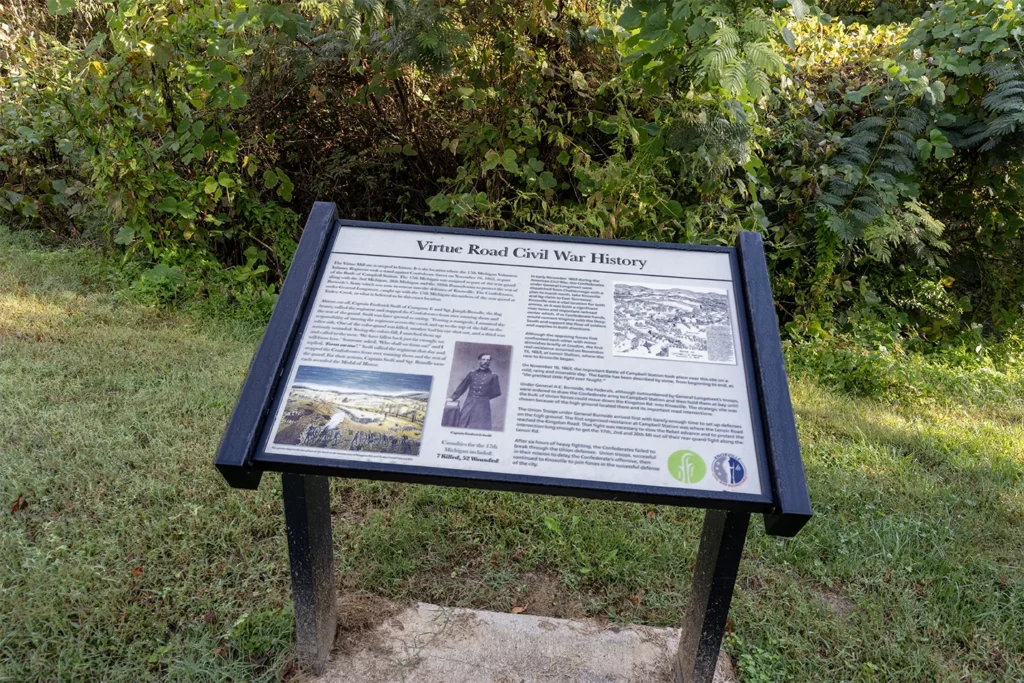
Visitors to the waterwheel can now find an interpretive sign explaining the site’s Civil War history.
The Virtue Road Civil War History marker was unveiled on Veterans Day, November 11, 2024, at the Virtue Road entrance to the greenway.
The Knoxville Civil War Roundtable funded the sign through a preservation grant, and the marker documents the 17th Michigan’s stand against Confederate forces during the Battle of Campbell’s Station.
The marker states that the encounter with the 17th Michigan’s skirmishers is believed to have occurred at the Virtue Mill location. It also records the regiment’s seven killed and 52 wounded.
What Remains of Virtue Mill Today?
The mill building itself no longer survives.
What remains is the waterwheel, the creek and the historic site.
That makes the wheel more than an unusual piece of machinery sitting beside a trail.
It is a physical reminder of a property whose history reaches from a 19th-century mill through the Civil War, later community use, preservation efforts and ultimately the loss of the mill building itself.
The Town of Farragut has formally recognized both Virtue Mill and the nearby war memorial among the community’s historically significant locations.
And today, the site is much easier to reach than it once was.
How Can You See the Virtue Mill Waterwheel Today?
Modern access comes by way of Farragut’s greenway network.
In March 2024, the Town opened an extension of the Little Turkey Creek Greenway. The new section created a connection among the Sheffield, Vista, Brookmere and Sugarwood areas and toward Kingston Pike.
One feature was designed specifically around this historic location: a small three-car parking area off Virtue Road and a paved trail leading down to the Virtue Mill waterwheel.
That creates an unusual overlap between Farragut’s past and present.
A location that once supported a working mill and later became part of a Civil War battlefield can now be approached on foot from a modern greenway.
Local Observation
I came across this history while walking and documenting Farragut’s greenway connections. I knew the old waterwheel was there, but digging into why it was there led to a much larger story—the former Virtue Mill, the Battle of Campbell’s Station and the 17th Michigan’s fight around Little Turkey Creek.
That’s one reason I’ve enjoyed exploring Farragut on foot. Places that seem familiar from a car can look very different when you slow down enough to notice what’s actually there.
Virtue Road today looks nothing like it would have in the 1800s. Neither does Kingston Pike, Campbell Station Road or most of the surrounding area.
But walk down the trail toward Little Turkey Creek and there is still a waterwheel beside the stream.
Then read the Civil War marker and consider that Union soldiers were trying to get themselves, their regiment and their colors across this same creek while Confederate troops were advancing behind them.
It puts a familiar Farragut location into an entirely different context.
That’s one of the things I’m discovering as I spend more time walking and documenting Farragut: sometimes the interesting part isn’t simply where a road or trail takes you.
It’s what was there before the road or trail existed.
Frequently Asked Questions About Virtue Mill and the Battle of Campbell’s Station
What was Virtue Mill?
Virtue Mill was a historic mill along Little Turkey Creek near Virtue Road in present-day Farragut. Local historical sources date its construction to sometime in the 1840s or 1850s. The property served various functions over its history, and the mill was no longer operating by the late 20th century.
Does Virtue Mill still exist?
The mill building does not. It was destroyed by fire on June 2, 2002, while preservation and restoration efforts were underway. Its waterwheel remains at the site.
Where is the Virtue Mill waterwheel?
The waterwheel is near Virtue Road and Little Turkey Creek in Farragut. A paved trail from a small parking area off Virtue Road provides access to the historic site.
Was the Battle of Campbell’s Station fought at Virtue Mill?
The Virtue Mill area was one location involved in the larger Battle of Campbell’s Station. The newer historical marker at the mill site says the 17th Michigan’s encounter with Confederate forces is believed to have occurred there. The overall battle extended across a much larger area of present-day Farragut.
When was the Battle of Campbell’s Station?
The Battle of Campbell’s Station was fought on November 16, 1863, during Longstreet’s Knoxville Campaign.
Who fought in the Battle of Campbell’s Station?
Union forces under Maj. Gen. Ambrose Burnside fought Confederate forces under Lt. Gen. James Longstreet. Numerous units participated, including the 17th Michigan Volunteer Infantry.
Why was Campbell’s Station important?
Campbell’s Station was a critical crossroads on the route to Knoxville. Burnside wanted to reach the crossroads and continue toward Knoxville’s defenses, while Longstreet hoped to get there first and force Burnside to fight before reaching those defenses.
Who were Frederick Swift and Joseph Brandle?
Frederick Swift and Joseph Brandle served with the 17th Michigan Volunteer Infantry. Both were later awarded the Medal of Honor for their actions during the November 16, 1863 fighting as the regiment withdrew toward Knoxville.
How many soldiers were killed or wounded in the 17th Michigan action?
Historical markers documenting the action report seven members of the 17th Michigan killed and 52 wounded.
Is there a Civil War marker at the Virtue Mill site?
Yes. The Virtue Road Civil War History interpretive marker was unveiled in November 2024. It explains the 17th Michigan’s action at Little Turkey Creek as part of the Battle of Campbell’s Station.
Can you walk to the Virtue Mill waterwheel?
Yes. A paved trail leads from a small parking area off Virtue Road to the historic waterwheel. The trail is part of the Little Turkey Creek Greenway extension completed in 2024.
One Farragut Location, Several Layers of History
The Virtue Mill building is gone, and the Farragut surrounding it has changed dramatically.
But the waterwheel still stands beside Little Turkey Creek.
It marks a place where several periods of local history overlap: a mill dating to the mid-1800s, fighting during the Battle of Campbell’s Station, a community landmark that survived into the 21st century and a modern effort to preserve the site’s history even after the building itself was lost.
Today, you can walk down a paved trail from Virtue Road and see that history in the landscape.
For anyone interested in understanding Farragut beyond what can be seen from Kingston Pike or a subdivision map, the Virtue Mill waterwheel is a good reminder that some of the Town’s history is still sitting quietly beside the places we pass every day.
Sources & Local Resources
- National Park Service — Battle of Campbell’s Station — Overview of the November 16, 1863 battle, including Burnside and Longstreet’s race to Campbell’s Station, the strategic crossroads, troop movements and estimated casualties.
- National Park Service — Knoxville Campaign, Part II — Broader context for the Knoxville Campaign, including the Battle of Campbell’s Station, Burnside’s withdrawal to Knoxville and the events that followed.
- Town of Farragut — Spring 2024 Talk of the Town: Little Turkey Creek Greenway — Official Town account of the 2024 greenway extension, including the Virtue Road parking area, paved access to the historic Virtue Mill waterwheel and the site’s connection to the 17th Michigan.
- Town of Farragut — Comprehensive Land Use Plan, Figure 12: Identified Historic Locations — Town planning document identifying historic locations in Farragut, including Virtue Mill and the War Memorial at Virtue Mill in Figure 12.
- Knoxville Civil War Roundtable — Wartime Miller of the Virtue Grist Mill? — Research into the early history and ownership of Virtue Mill, including what is known—and remains uncertain—about the mill during the Civil War period.
- Historical Marker Database — Virtue Road Civil War History Marker — Documents the interpretive marker at the Virtue Mill site and the 17th Michigan’s action around Little Turkey Creek during the Battle of Campbell’s Station.
- Historical Marker Database — Medal of Honor, 17th Michigan Volunteer Regiment — Documents the nearby historical marker describing the 17th Michigan’s rear-guard action and the Medal of Honor actions of Frederick Swift and Joseph Brandle.
Exploring Farragut, Tennessee
LivingInFarragut.com is where I document the places, trails, residential areas and local history I discover while exploring Farragut firsthand.
Explore more about living in Farragut →
David Hamilton, REALTOR®
Weichert, Realtors – Advantage Plus
Cell: 865-284-HOME
Office: 865-474-7100
Email: david@davidhamilton.com