Understanding the Farragut, TN Housing Market | Part 2
The Farragut Rental Opportunity | September 2026
Quick Answer
Quick Answer
A Farragut, TN rental property can occupy an interesting place in today’s housing market. Home values rose rapidly over the past several years, putting many properties beyond the comfortable purchasing range of some households that may still be able to afford market-rate rent. Some of those households may choose to rent instead of buy.
At the same time, single-family rental inventory in Farragut is limited. A September 18, 2026 FlexMLS search found only five active single-family rental listings matching the Farragut-area criteria used for this analysis.
That combination may create an opportunity for rental-property investors, particularly in established neighborhoods such as Kings Gate and Stonecrest, where older homes can sometimes be acquired well below Farragut’s overall typical home value.
But limited rental supply does not automatically make a Farragut, TN rental property a good investment. Actual closed rental transactions show that condition, size, acquisition price and improvements can materially affect achievable rent.
The key is not simply buying in Farragut.
The key is buying selectively.
The Affordability Gap Is Creating a Different Kind of Housing Demand
In Part 1 of this series, I examined whether a household earning under $100,000 can afford to buy a home in Farragut. There isn’t one answer because income alone doesn’t determine affordability, but the larger trend is difficult to miss.
Not that many years ago, a household earning $100,000 in East Tennessee could reasonably expect that income to provide considerable housing choice while still leaving room for savings, vehicles, vacations, retirement contributions and the ordinary expenses of life.
The housing market changed much faster than many household budgets did.
As of August 31, 2026, Zillow reported a typical Farragut home value of approximately $691,336, up 1.9% from a year earlier. The reported median sale price was approximately $762,500 in July, while the median list price reached approximately $805,750 in August.
Those figures don’t mean every Farragut house costs $700,000 or $800,000. They do illustrate how wide the gap has become between many household incomes and the cost of purchasing a typical home here.
The market is also evolving again. East Tennessee REALTORS® has reported signs of a more balanced market, including somewhat greater negotiating flexibility for buyers and fewer surveyed agents expecting home prices to increase over the coming year than at the same point in 2025.
That may slow the growth of the affordability gap.
It doesn’t erase the gap that has already developed.
That distinction is important for both buyers and potential rental-property investors.
A Household Doesn’t Have to Buy a Farragut Home to Afford to Live Here
A household may be able to comfortably afford market-rate rent without being comfortable purchasing a $600,000, $700,000 or $800,000 home.
Some will purchase in another community. Others may wait to buy, particularly as the housing market becomes more balanced.
But some will rent.
Renting doesn’t necessarily mean a household lacks the financial resources to purchase a home. A household may simply decide that purchasing a Farragut home at current prices isn’t the right financial decision for its circumstances.
Single-family rentals can also provide something apartments generally don’t: additional bedrooms, private outdoor space, garages and the experience of living in an established residential neighborhood.
For a rental-property investor, that raises an interesting question:
Has the widening gap between the cost of buying in Farragut and the cost of renting created an underserved market for single-family rental homes?
The available evidence suggests the question is worth investigating.
Farragut Has Limited Single-Family Rental Inventory
This isn’t just a Farragut phenomenon. National Association of REALTORS® research found that average renter tenure increased from approximately 5.9 years in 2019 to 6.5 years in 2024. NAR’s analysis points to housing affordability as one factor contributing to renters remaining in place longer.
National Context: Read NAR’s analysis, Renters Are Staying Longer, and It’s Not Just Homeowners Who Are Feeling Locked In.
What this means in Farragut: National renter behavior doesn’t establish rental demand in Farragut by itself, but it helps explain the broader environment behind the local affordability gap. To determine whether that translates into a local opportunity, we have to look at Farragut’s actual rental inventory and what tenants have actually paid.
At the time of my September 18, 2026 analysis, a FlexMLS search showed only five active single-family rental listings matching the Farragut-area criteria used for this analysis.
The asking rents ranged from approximately $2,350 to $4,100 per month, with a median asking rent of approximately $2,795.
That should not be interpreted to mean only five houses were available for rent throughout all of Farragut. Some owners market properties privately, some use other rental platforms, and inventory changes continuously. This is simply a point-in-time snapshot of properties matching the MLS search criteria.
It is nevertheless a useful indicator.
More importantly, we don’t have to rely on asking rents to understand the market. FlexMLS also gives us closed rental transactions showing what tenants actually agreed to pay.
What Comparable Farragut Homes Have Actually Rented For
I reviewed closed rental transactions involving three- and four-bedroom single-family homes in established Farragut neighborhoods. Several are particularly useful because they represent the older housing stock an investor might encounter at acquisition prices below Farragut’s overall market.
| Neighborhood | Approx. Size | Bedrooms | Condition/Improvements Noted in MLS | Actual Monthly Rent | Rented |
|---|---|---|---|---|---|
| Kings Gate | ~1,925 sf | 4 | Some updates | $2,150 | Aug. 2026 |
| Kings Gate | ~1,800 sf | 4 | Renovated bathrooms | $2,200 | Aug. 2026 |
| Kings Gate | ~1,730 sf | 4 | Extensively remodeled | ~$2,700 | Aug. 2026 |
| Kings Gate | ~2,350 sf | 4 | Multiple updates | $2,700 | July 2025 |
| Kings Gate | ~1,850 sf | 4 | Updated, move-in ready | $2,395 | Mar. 2025 |
| Stonecrest | ~1,800 sf | 4 | Fully renovated | $2,700 | May 2025 |
Source: East Tennessee REALTORS® / FlexMLS closed rental transactions reviewed September 18, 2026. Figures are historical transactions and are not estimates or guarantees of current or future rent.
That table tells us something much more useful than simply saying, “Farragut rents are high.”
It shows that the property has to earn the rent.
The older Kings Gate examples with more modest updating rented in roughly the low-to-mid $2,000s. Properties reaching approximately $2,700 tended to offer substantial renovation, more square footage or other improvements that helped distinguish them.
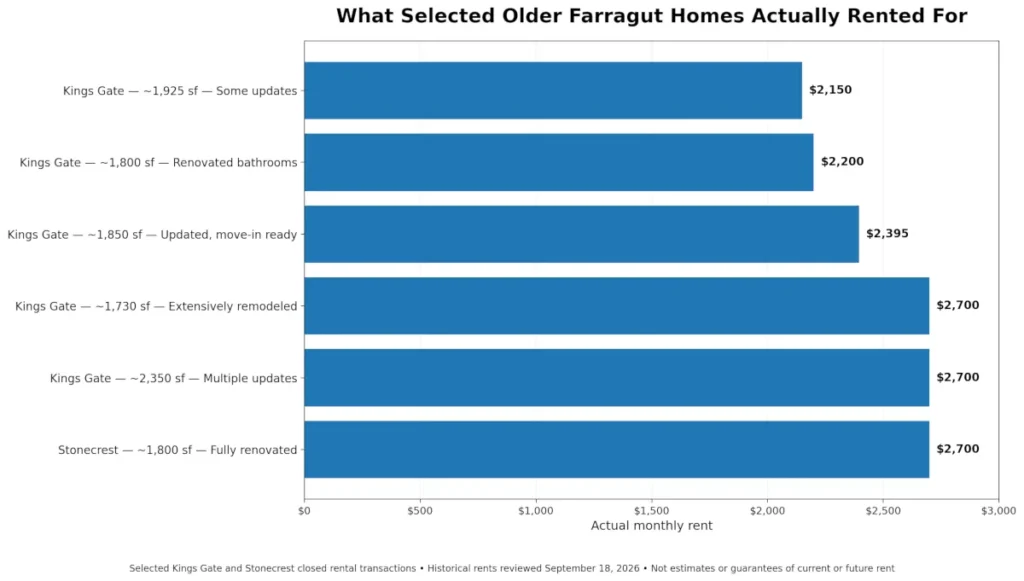
An investor therefore shouldn’t find the highest rent in a neighborhood and assume another house will achieve it.
The correct question is:
What would this particular property realistically rent for in its present condition?
Where Are Some of Farragut’s Older Homes?
This is also useful information for someone relocating to Farragut who may not be familiar with the community’s housing stock.
Farragut isn’t exclusively newer subdivisions and luxury homes. Established neighborhoods including Kings Gate and Stonecrest contain homes dating primarily from earlier periods of Farragut’s development, including many houses from the 1960s and 1970s.
For buyers, these neighborhoods can offer an alternative to newer construction. Depending on the individual property, that may mean mature lots, established streets and an acquisition price below newer or larger homes elsewhere in Farragut.
For an investor, the same characteristics can create opportunity—but they also make property condition especially important.
Two houses built within a few years of one another can now be very different properties. One owner may have replaced the roof, windows, HVAC equipment, electrical components and plumbing and remodeled the interior. Another house of the same age may still have several expensive projects ahead.
That’s why neighborhood and age are only starting points.
The individual house still has to make sense.
The Opportunity Is in Buying Selectively
Farragut’s overall home values make this particularly important.
If an investor purchases near Farragut’s typical home value and then attempts to support that acquisition price with ordinary single-family rent, the economics may be difficult.
The more interesting question is whether established neighborhoods occasionally provide a lower acquisition basis while still supporting market rent for a single-family home.
During my September 18, 2026 review, there were active homes in established Farragut neighborhoods offered in the $400,000s, materially below Farragut’s overall typical home value of approximately $691,000.
I’m intentionally not identifying or evaluating individual active listings here. Asking prices and property availability change, and whether a particular home represents an investment opportunity requires a property-specific analysis.
The larger point is that my September 18, 2026 review found a lower acquisition-price range within Farragut.
An investor can then compare three things:
- Acquisition: What will it actually cost to purchase the property?
- Condition: What repairs, improvements and major replacements are likely now or during the holding period?
- Income: What rent is supported by comparable properties in similar condition—not by the highest rent someone hopes to achieve?
When those three numbers work together, a property deserves a closer look.
When they don’t, the fact that the house happens to be in Farragut doesn’t fix the problem.
Purchase Price Is Only the Beginning
This is where my background in residential contracting affects how I look at investment property.
With a 1960s or 1970s house, I don’t want to know only whether the kitchen has granite countertops or whether the flooring photographs well. Cosmetic improvements matter to tenants, but expensive building components can matter much more to the owner.
Some of the items I would want an investor to consider include:
- Roof age and remaining useful life
- HVAC age, condition and service history
- Electrical service and major electrical updates
- Supply and drain plumbing
- Windows and exterior components
- Drainage, moisture and foundation conditions
- Decks, driveways and other costly exterior improvements
- Water heater and major appliances
- Improvements necessary for the property to compete with rentals being used as comparables
None of those items automatically makes an older house a poor investment. In fact, a well-maintained older house purchased at an appropriate price may make considerably more sense than a newer property purchased at a much higher price.
The point is that cheap and inexpensive aren’t necessarily the same thing.
Suppose an investor finds a house priced substantially below comparable Farragut homes but discovers after purchase that it needs several major systems replaced. The lower purchase price may not represent the bargain it initially appeared to be.
Conversely, paying somewhat more for a house where major capital items have already been addressed can sometimes produce better economics.
The meaningful number isn’t simply the purchase price. It’s closer to the purchase price plus the cost of getting and keeping the property into the condition necessary to produce the expected rent.
Does the Property Actually Work as an Investment?
Once a realistic rent has been established and the property’s condition is understood, the financial analysis can begin.
Gross rent is only the starting point. An investor also needs to consider vacancy, property taxes, landlord insurance, routine maintenance, future capital replacements, property management where applicable, HOA expenses if any, and other ownership costs.
Farragut has one unusual characteristic worth mentioning here: the Town does not levy a municipal property tax. Farragut property owners pay Knox County property taxes, with residential property assessed at 25% of market value.
That doesn’t make operating expenses disappear, but it is an important distinction for someone relocating from a community that levies both county and municipal property taxes.
For investment analysis, I prefer starting with the property’s income before financing. One common measurement is the capitalization rate, or cap rate, which compares net operating income with property value.
The important part isn’t memorizing a formula. It’s understanding that $30,000 of annual rent is not $30,000 of annual profit.
An investor should build reasonable allowances for the expenses that inevitably come with owning a house rather than assuming every dollar of rent becomes income.
Only after the property itself has been evaluated does it make sense to consider how an individual investor might choose to finance the purchase. Financing, taxes and investment structure can materially change an individual’s return and should be evaluated with the appropriate lending, financial and tax professionals.
What About Appreciation?
This question is becoming particularly relevant as East Tennessee’s housing market normalizes.
If the extraordinary pace of home-price growth of recent years is easing, an investor might reasonably ask whether it makes sense to buy now or wait.
That’s an important question—but it’s also a reason I wouldn’t build an investment case around appreciation.
A more balanced market does not automatically mean home values will fall. Slower appreciation and depreciation are two different things. In August 2026, Zillow still showed Farragut’s typical home value 1.9% higher than a year earlier, even as broader East Tennessee indicators pointed toward more balanced conditions.
Future appreciation may ultimately add significantly to an owner’s long-term return.
It may not.
I would rather evaluate a rental property based on today’s acquisition price, today’s defensible market rent and realistic operating expenses. Potential appreciation can then be viewed as one possible component of a long-term investment rather than something required to make weak numbers work.
That principle applies equally well to someone wondering whether to wait before purchasing a primary residence, which is a subject I’ll address separately.
Rental Real Estate Can Build Wealth—But It Isn’t Effortless Wealth
Rental real estate can provide income, potential long-term appreciation and an asset an owner can physically improve. For some investors, those characteristics make real estate an attractive part of a broader wealth-building strategy.
But calling rental property “passive income” can make ownership sound more passive than it really is.
Roofs wear out. HVAC systems fail. Tenants move. Properties sometimes sit vacant. Appliances break. Insurance and taxes change. Property managers can reduce the owner’s workload, but management has a cost.
Real estate is also relatively illiquid. Selling a house generally takes more time and carries greater transaction costs than selling many other types of investments.
Those aren’t reasons not to own rental property. They’re reasons to analyze one realistically.
So, Is a Farragut Rental Property a Good Investment?
There isn’t one answer because Farragut isn’t the investment. The individual property is.
The affordability gap suggests there may be households with sufficient income to rent a single-family home in Farragut even though purchasing the home they want isn’t currently attractive or comfortable for them.
The limited number of active rentals in the MLS snapshot suggests that single-family rental supply deserves attention.
And actual closed rental transactions in neighborhoods such as Kings Gate and Stonecrest demonstrate the rents achieved by several older Farragut homes—particularly when those properties are appropriately updated.
But none of that means an investor should simply buy whatever becomes available.
A potential rental still has to pass several tests:
- Is the acquisition price reasonable relative to realistic rent?
- Does the property’s present condition support that rent?
- What major expenses are likely during the holding period?
- What does the property produce after realistic operating expenses and reserves?
- Does the investment still make sense without assuming aggressive future rent increases or appreciation?
That’s what I mean by buy selectively.
The opportunity isn’t simply that Farragut has expensive homes and limited rentals. The opportunity may exist because a widening affordability gap has created households that can afford to live in Farragut but may not be able—or may not choose—to purchase the home they want here.
For an investor, however, that demand only matters if the property can be acquired at a price and in a condition that makes today’s realistic rent work.
The property has to earn the rent.
Frequently Asked Questions
Why would someone rent a house in Farragut instead of buying one?
There are many possible reasons. A household may have sufficient income to afford market rent but prefer not to commit the capital required to purchase at current Farragut prices. Others may be relocating, waiting for greater certainty about how long they’ll remain in the area, or simply prefer renting. Financial circumstances and preferences vary by household.
Where can buyers find older homes in Farragut?
Established neighborhoods such as Kings Gate and Stonecrest contain many homes from earlier periods of Farragut’s development, including 1960s- and 1970s-era housing. Individual properties vary substantially because some have undergone extensive renovation while others retain more original components.
How much do single-family homes rent for in Farragut?
Rent varies considerably according to size, condition, location and amenities. In the closed MLS transactions reviewed for this September 18, 2026 analysis, several older three- and four-bedroom homes in established Farragut neighborhoods rented in roughly the low-to-upper $2,000s per month. Several substantially renovated four-bedroom examples reached approximately $2,700.
Does Farragut have a city property tax?
No. The Town of Farragut does not levy a municipal property tax. Farragut residents pay Knox County property tax. Residential property is assessed at 25% of market value.
Does a more balanced real estate market mean Farragut home prices will fall?
Not necessarily. A more balanced market can mean buyers have more choices, homes take longer to sell, negotiations become more common or appreciation slows. None of those conditions automatically means prices are declining. Market conditions should be evaluated using current local data.
Should an investor assume a Farragut property will appreciate?
Future appreciation isn’t guaranteed. I would not use assumed appreciation to make an otherwise weak rental investment appear attractive. The first analysis should be based on acquisition price, realistic current rent, property condition and operating expenses.
What should I investigate when considering an older Farragut rental property?
Beyond cosmetic appearance, pay particular attention to major components such as roofing, HVAC, electrical systems, plumbing, windows, drainage, foundation conditions and exterior components. The cost and remaining useful life of those items can materially change the economics of the investment.
Coming Next: Should You Wait to Buy in Farragut?
The affordability gap and limited rental inventory raise another question for people who still want to own a home in Farragut: Would it make more sense to wait?
Buyers have more choices and somewhat more negotiating flexibility than during the most competitive years. But a better market for buyers doesn’t necessarily mean a cheaper market for buyers, and Farragut remains tighter than the broader Knoxville market.
In Part 3 of Understanding the Farragut, TN Housing Market, we look at what changing market conditions actually mean, the difference between slower appreciation and falling home prices, and the circumstances in which waiting to buy may—or may not—make sense.
Next: Should I Wait to Buy a Home in Farragut? What a More Balanced Market Really Means →
Considering a Farragut Rental Property?
Rental statistics and investment calculations can help identify a potential opportunity, but ultimately you’re buying a particular house.
Its purchase price matters. Its realistic rental potential matters. Its ongoing expenses matter. And especially with Farragut’s older housing stock, its condition matters.
My background includes approximately three decades in residential contracting in addition to my real-estate experience. When evaluating a potential rental property, I’m interested in more than what a spreadsheet says the property could produce. I want to understand what has already been improved, what hasn’t, what may need attention next—and whether the condition of the property supports the rent an investor is expecting.
The property has to earn the rent.
I can help you consider the property itself alongside the numbers.
Want to see what’s currently available? Browse Farragut homes for sale and look at today’s inventory through an investor’s lens.
Search Farragut Homes for Sale →
David Hamilton, REALTOR®
Weichert, Realtors – Advantage Plus
Farragut & West Knoxville, Tennessee
This article is provided for general real-estate education and market discussion. It is not financial, investment, tax, legal or lending advice and does not constitute an offer of credit or a representation or guarantee of future rental income, occupancy, appreciation, cash flow or investment performance. Rental rates, property availability and market conditions change. Investors should independently verify property condition, market rent, operating expenses and other assumptions and consult appropriate financial, tax, legal, insurance and lending professionals regarding their individual circumstances.
Sources & Market Data
East Tennessee REALTORS® / FlexMLS
Based on information from the East Tennessee REALTORS® MLS for the period March 1, 2025 through September 18, 2026. Active rental availability reflects a point-in-time search conducted September 18, 2026. Closed rents referenced in this article are historical MLS transactions and are not estimates or guarantees of current or future rent. Active rental inventory should not be interpreted as the total number of rental properties available through every possible source.
East Tennessee REALTORS® — Q2 2026 Market Pulse Survey
Survey conducted July 1–17, 2026. Referenced for broader East Tennessee housing-market conditions and indications of movement toward a more balanced market.
National Association of REALTORS® — Renters Are Staying Longer, and It’s Not Just Homeowners Who Are Feeling Locked In
Referenced for national renter-tenure trends and NAR’s discussion of housing affordability as one factor contributing to longer renter tenure.
Zillow — Farragut, Tennessee Housing Market
Farragut home-value, sale-price and listing-price data through August 2026.
Town of Farragut — General Facts
Referenced for Farragut property-tax information. The Town does not levy a municipal property tax; Farragut residents pay Knox County property tax, and residential property is assessed at 25% of market value.


3 thoughts on “They Can Afford the Rent—But Not the Mortgage: Why Farragut, TN Rental Investors Need to Buy Selectively”