Understanding the Farragut, TN Housing Market | Part 1
The Farragut Affordability Gap | September 2026
Quick Answer
Buying a home in Farragut, Tennessee, on a household income below $100,000 has become increasingly challenging because local home prices have risen much faster than many household budgets.
As of August 2026, Zillow reported a typical Farragut home value of approximately $691,000. The reported median sale price for July was approximately $762,500, while the median list price in August was approximately $805,750.
That doesn’t mean a household earning less than $100,000 cannot buy a home in Farragut. Available cash or equity, existing debt, credit, financing, taxes, insurance, savings and the particular property all affect affordability.
The larger issue is the affordability gap: the growing distance between what many households earn and what it costs to purchase a typical home in Farragut.
As East Tennessee’s housing market becomes more balanced, buyers may gain more choices and negotiating flexibility. But a slower market doesn’t automatically erase the affordability gap that developed during the rapid run-up in home prices.
The $100,000 Household Isn’t What Changed. The Housing Market Did.
Not that many years ago, a household earning $100,000 in East Tennessee could reasonably expect that income to provide considerable housing choice while still leaving room for savings, vehicles, vacations, retirement contributions and the ordinary expenses of life.
Today, $100,000 is still a substantial household income.
What changed dramatically was the housing market around it.
Home prices rose rapidly over a relatively short period. Borrowing costs later increased from their unusually low levels. Homeowners insurance, maintenance, construction materials and many of the other expenses associated with owning a house also became more expensive.
Household incomes didn’t necessarily keep pace with all of those changes.
The result is the affordability gap we’re seeing today.
According to Zillow, the typical Farragut home value was approximately $691,336 as of August 31, 2026, up 1.9% from a year earlier. Zillow also reported a median sale price of approximately $762,500 for July and a median list price of approximately $805,750 in August.
Those numbers don’t mean every Farragut house costs $700,000 or $800,000. Farragut contains homes at many price points, including older houses, smaller properties, condominiums and homes requiring varying degrees of updating.
But the market-wide figures illustrate why households earning $75,000, $90,000 or even $100,000 can find Farragut difficult to enter.
This isn’t exclusively a Farragut issue, either. The National Association of REALTORS® reported that home prices increased in 80% of U.S. metropolitan markets during the second quarter of 2026, up from 71% during the first quarter. The national median price of an existing single-family home reached $434,900 during the quarter.
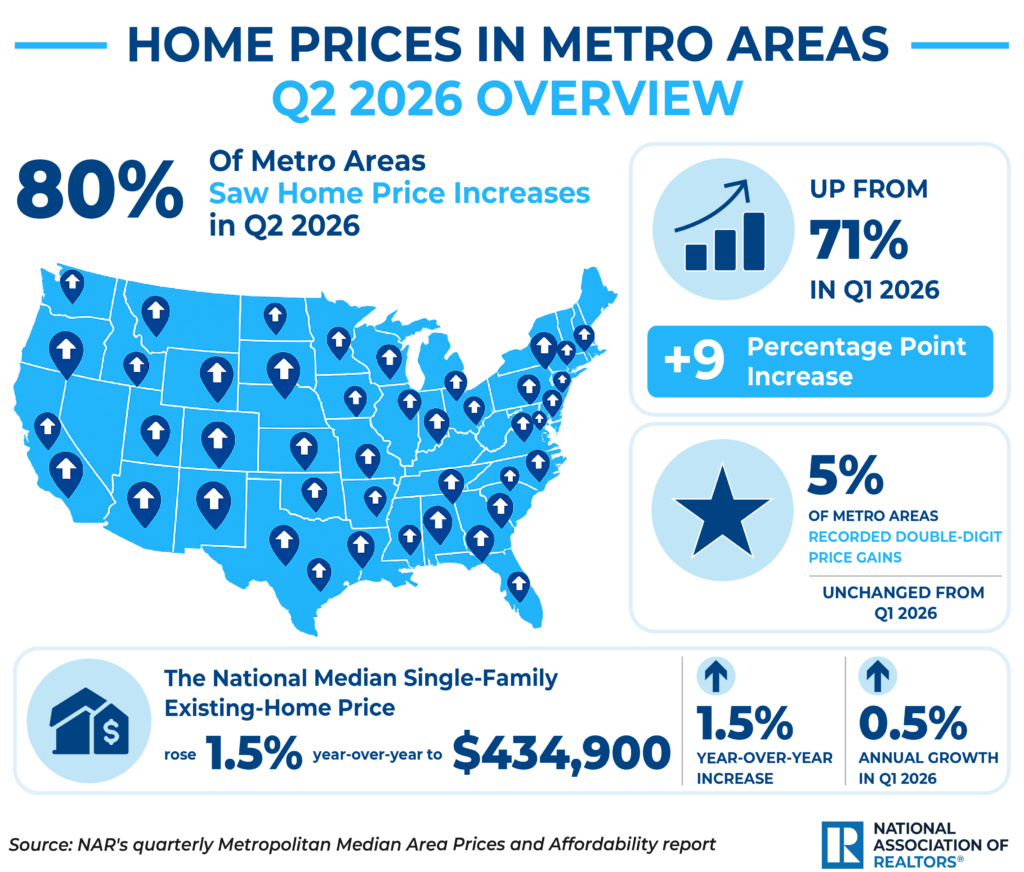
What this means in Farragut: The national trend provides important context, but Farragut begins at a considerably higher price point. With a typical local home value of approximately $691,000, the gap between household income and home prices can be substantially wider here than the national figures alone suggest.
Can a Household Earning Under $100,000 Still Buy in Farragut?
Potentially, yes. But household income by itself cannot answer that question.
Two households earning exactly the same amount can be in completely different financial positions. One may have substantial savings, very little debt and considerable equity from a previous home. Another may have vehicle payments, student loans, credit-card debt and limited savings.
Their incomes may be identical, but their comfortable housing budgets aren’t.
There is also an important difference between mortgage qualification and comfortable affordability. A qualified mortgage professional can help a buyer determine financing options and qualification. The buyer still has to decide how much of the household budget should reasonably be devoted to housing.
Before deciding what to spend, I think buyers should consider questions such as:
- How much cash or equity will remain after the purchase?
- What other monthly debts and obligations does the household carry?
- Are retirement savings or other financial goals being sacrificed to make the housing payment?
- How much emergency reserve will remain after closing?
- What are the taxes, insurance and other ongoing ownership costs?
- What repairs or major replacements might the particular house require?
That’s why I wouldn’t begin a Farragut home search by asking, “What’s the most expensive house I can get approved to buy?”
A better starting point is determining what housing expense fits comfortably into the buyer’s overall financial life and then seeing what the Farragut market actually offers at that level.
Affordability Becomes an Inventory Problem
Once a buyer establishes a comfortable budget, the next question is more practical:
What can that buyer actually purchase in Farragut?
At the lower end of Farragut’s housing market, buyers may encounter a different mix of properties than they would at the community’s overall typical price level.
| A Buyer May Encounter | What Deserves Closer Attention |
|---|---|
| Older single-family homes | Major systems, deferred maintenance and renovation history |
| Smaller homes | Whether the size and layout meet long-term needs |
| Condominiums or attached homes | HOA expenses, restrictions and included maintenance |
| Homes needing updating | Difference between cosmetic work and expensive repairs |
| Established neighborhoods | Individual property condition can vary considerably |
None of those categories is inherently good or bad.
An older, well-maintained house can represent excellent value. A condominium may be exactly what a particular buyer needs. A property needing cosmetic improvements can provide an opportunity for someone willing to do the work.
The problem comes when a buyer focuses exclusively on the asking price.
A $400,000 house requiring substantial near-term repairs isn’t economically the same as a $400,000 house where the major systems have already been addressed.
That distinction becomes especially important in Farragut because some established neighborhoods contain substantial numbers of homes built during the 1960s and 1970s.
Those properties can sometimes provide a lower entry point into Farragut—but the individual house matters enormously.
The Asking Price Is Only One Number on a House
My background before focusing on real estate was residential contracting. After approximately three decades in the contracting business, I tend to look beyond the features that are easiest to see in listing photographs.
Fresh paint, new countertops and updated flooring are certainly appealing. But they’re not necessarily the items that determine whether an older house remains affordable after closing.
With an older property, some of the things I want to understand include:
- Roof age and remaining useful life
- HVAC age and condition
- Electrical service and major updates
- Supply and drain plumbing
- Windows and exterior components
- Drainage and moisture conditions
- Foundation or structural concerns
- Decks, driveways and other potentially expensive exterior components
- Water heater and major appliances
- Evidence of deferred maintenance
Consider two similarly priced homes. One has a recently replaced roof, updated HVAC equipment, modernized electrical components and well-maintained plumbing. The other needs several of those items addressed during the next few years.
Their asking prices might be almost identical.
Their true cost of ownership isn’t.
That’s why property condition is part of affordability. Buyers shopping below Farragut’s typical price level shouldn’t assume the least expensive house is necessarily the least expensive house to own.
A More Balanced Market May Help Buyers—But It Doesn’t Erase the Gap
There is another question buyers are beginning to ask:
If the market is becoming more balanced, should I wait to buy?
East Tennessee REALTORS® has reported signs of a more balanced regional market, including somewhat greater negotiating flexibility for buyers and fewer surveyed agents expecting home prices to increase over the following year than at the same point in 2025.
That’s meaningful.
A more balanced market can provide buyers with benefits that were difficult to find during an extremely competitive seller’s market. Depending on the property, buyers may have more time to evaluate a home, more inventory from which to choose or greater ability to negotiate price, repairs or other terms.
But a more balanced market doesn’t necessarily mean a declining market.
Slower appreciation and depreciation are two different things.
Zillow still reported Farragut’s typical home value 1.9% higher year over year as of August 2026, even as broader East Tennessee indicators suggested market conditions were becoming more balanced.
So should a buyer wait?
There isn’t one answer.
Waiting could make sense for someone who needs additional time to save, reduce debt, improve financial flexibility or better understand where they want to live. A changing market could also provide additional inventory or negotiating opportunities.
But waiting solely because someone expects Farragut home prices to fall substantially is a different decision—and one that depends on something nobody can know with certainty: future market prices.
For most buyers, I think the more useful question is not “Can I perfectly time the market?”
It’s “Am I financially ready, and can I find the right house at a price and condition that make sense for me?”
The broader question of whether buyers should wait as appreciation slows deserves its own discussion, and I’ll address that separately.
What If Buying in Farragut Doesn’t Make Sense Right Now?
Sometimes the answer after looking at the numbers and available inventory is simply: not yet.
That’s not necessarily a bad outcome.
A household may decide to broaden its geographic search, consider a different type or size of property, continue saving, wait for a particular neighborhood or property type, or rent for a period of time.
That last option is particularly interesting in Farragut.
Consider a household that wants to live in Farragut but finds that purchasing the type of home it wants either doesn’t fit comfortably into its finances or simply doesn’t make sense at this stage.
That household doesn’t disappear from the housing market.
It may become a renter.
And renting a home and purchasing the same home are very different financial decisions. A renter doesn’t have to commit the capital necessary to acquire the property or assume responsibility for the major long-term repair and replacement expenses associated with ownership.
That raises the possibility of rental demand from households that may be willing and able to pay market rent for a single-family home while being unwilling or unable to comfortably purchase a comparable Farragut property.
Then we encounter the other side of the equation:
Farragut doesn’t have an unlimited supply of single-family rental homes.
At the time of my September 18, 2026 analysis, a FlexMLS search showed only five active single-family rental listings matching the Farragut-area criteria used for this analysis.
That is a point-in-time MLS snapshot, not a count of every rental property in Farragut. Privately marketed rentals and properties advertised through other sources may not appear in that data.
But it raises an interesting question.
Could the affordability gap between buying and renting create an opportunity for someone interested in owning rental property in Farragut?
That’s where Part 2 begins.
From Affordability Gap to Investment Opportunity
The answer isn’t as simple as buying a house in Farragut and finding a tenant.
Farragut’s high property values can make rental economics challenging. An investor still has to purchase at a price where realistic market rent can support the investment.
That’s why the next article looks specifically at actual closed rental transactions in established Farragut neighborhoods, including Kings Gate and Stonecrest.
Those transactions reveal something particularly important: similarly sized older homes don’t necessarily command similar rents. Condition, renovation, acquisition price and future capital expenses can materially change the economics.
In other words:
The property has to earn the rent.
And if there’s an investment opportunity created by Farragut’s affordability gap, the key isn’t simply buying in Farragut.
It’s buying selectively.
Frequently Asked Questions
Can a household earning under $100,000 buy a home in Farragut?
Potentially. Income is only one factor. Available cash or equity, existing debt, credit, financing, taxes, insurance and the particular property all affect affordability. Farragut’s relatively high home prices can make the available choices more limited for households shopping below the market’s typical price level.
How much house can someone earning $100,000 afford?
There isn’t one responsible answer based solely on income. Two households earning the same amount can have substantially different debts, savings, available equity, financial goals and financing options. A mortgage professional can evaluate qualification, while the buyer should separately determine what housing expense is personally comfortable.
Are there lower-priced homes in Farragut?
Yes, lower-priced properties do appear, although inventory changes continuously. Options may include older homes, smaller properties, condominiums or homes requiring updates. Buyers should evaluate both the purchase price and the property’s condition and ongoing ownership costs.
Where can buyers find older homes in Farragut?
Established neighborhoods such as Kings Gate, Stonecrest and Farragut View contain many homes from earlier periods of Farragut’s development, including 1960s- and 1970s-era housing. Individual properties vary substantially because many have been renovated over the years while others retain more original components.
Does a more balanced housing market mean Farragut home prices will fall?
Not necessarily. A more balanced market can mean more inventory, longer marketing times or greater negotiating flexibility without necessarily producing declining home values. Slower appreciation and depreciation are different market conditions.
Should I wait to buy a house in Farragut?
That depends more on the buyer’s financial readiness, housing needs, expected length of ownership and available properties than on trying to predict short-term market movements. Buyers who need time to save or improve their financial position may benefit from waiting; buyers who are financially prepared may find increased negotiating flexibility valuable.
Is renting in Farragut an alternative to buying?
For some households, yes. Renting can provide access to the community without committing the capital required to purchase a home or assuming responsibility for major long-term property expenses. Single-family rental inventory, however, can also be limited.
Coming Next: The Farragut Rental Opportunity
For households that want to live in Farragut but aren’t ready—or aren’t able—to purchase at today’s prices, renting can become the practical alternative.
But Farragut has relatively limited single-family rental inventory. That raises another question: Could the same affordability gap creating challenges for buyers also create an opportunity for rental-property investors?
In Part 2 of Understanding the Farragut, TN Housing Market, we’ll look at Farragut’s rental inventory, what comparable homes have actually rented for, and why a potential investment only works if the property can be purchased at a price—and in a condition—that today’s realistic rent can support.
Considering a Home in Farragut?
Market statistics and affordability calculators can provide useful context, but ultimately you’re buying a particular house.
Its price matters. Its location matters. Its ongoing ownership costs matter. And especially with Farragut’s older housing stock, its condition matters.
My background includes approximately three decades in residential contracting in addition to my real-estate experience. When helping a buyer evaluate a property, I’m interested in more than whether the kitchen photographs well. I want to understand what has already been improved, what hasn’t, and what may need attention next.
If you’re considering buying in Farragut, I can help you evaluate the property itself as carefully as the price.
Ready to see what’s available? Browse current Farragut homes for sale and see what today’s inventory actually looks like.
[Search Farragut Homes for Sale →]
Thinking About Selling a Farragut Home?
Understanding where your property fits within today’s market—and what buyers are comparing it with—can help inform pricing, preparation and marketing decisions.
Start with an estimate of your home’s current value, then we can look more closely at the property itself and how it compares with today’s Farragut market.
[See What Your Home Is Worth →]
David Hamilton, REALTOR®
Weichert, Realtors – Advantage Plus
Farragut & West Knoxville, Tennessee
This article is provided for general real-estate education and market discussion. It is not financial, tax, investment or lending advice and does not constitute an offer of credit. Mortgage qualification, financing options and housing affordability depend on individual circumstances. Consumers should consult appropriate mortgage, financial, tax and other professionals regarding their particular situation.
Sources & Market Data
Zillow — Farragut, Tennessee Housing Market
Farragut home-value, sale-price and listing-price data through August 2026.
National Association of REALTORS® — Metropolitan Median Area Prices and Affordability, Q2 2026
National housing-price and affordability trends, including the percentage of metropolitan markets experiencing price increases and the national median existing single-family home price.
East Tennessee REALTORS® — Q2 2026 Market Pulse Survey
Survey conducted July 1–17, 2026. Referenced for broader East Tennessee housing-market conditions and indications of movement toward a more balanced market.
East Tennessee REALTORS® / FlexMLS
Based on information from the East Tennessee REALTORS® MLS as of September 18, 2026. Active rental availability represents a point-in-time MLS search and should not be interpreted as the total number of rental properties available through every source.


1 thought on “Can You Afford a Home in Farragut, TN If Your Household Earns Under $100,000?”